Moving Beyond “Luck”
Most players choose an online slot the same way they choose a movie: they look for a flashy thumbnail, a catchy title, or a familiar theme. They log in, click a game like Mystic Fortune or Dragon King, and start spinning without the slightest understanding of the mathematical engine driving their experience. While slots are undeniably games of chance, treating them as a pure mystery is a strategic error.
Success in a casino isn’t about finding a “winning system”—it is about using data to manage your bankroll and extend your play. Information is the only tool that gives you a fighting chance against the house. This guide is designed to bridge the gap between playing informed vs. playing blind.
The Brain of the Machine: Understanding the RNG
Every outcome of every spin is determined by a Random Number Generator (RNG). This software generates thousands of random numbers every second, 24/7. When you hit the “Spin” button, you aren’t starting a new cycle; you are simply capturing whatever number the RNG produced at that exact millisecond.
That number is instantly mapped to a reel outcome. The spinning reels you see are merely animations—a visual show to represent a result the software decided before the reels even moved.
Why Timing Doesn’t Matter
To understand the RNG, think of it as a constant coin flip. If you flip a coin and get heads five times in a row, the probability of tails on the sixth flip remains exactly 50%. The coin has no memory of the previous flips. The RNG operates on the same principle of total independence:
- A slot is never “due” for a win.
- Previous spins have zero impact on future outcomes.
- The speed of your clicks or “stop” buttons cannot influence the software’s pre-calculated result.
RTP: The Percentage Most Players Ignore
The Return to Player (RTP) is the theoretical percentage of wagered money a game returns to players over its entire statistical lifespan. The inverse of this is the House Edge—the casino’s guaranteed profit margin.
Online slots generally offer much better value than land-based machines. While a physical slot in a Vegas casino typically runs at an 85–92% RTP, the online industry average is much higher, between 95–97%.
Real-World Benchmarks
- 96% or higher: The industry “Gold Standard.” Games like Blood Suckers (98%) and Mega Joker (99%) are among the best mathematical deals available.
- 94% – 95%: Use caution; the house edge is doubling compared to top-tier games.
- Below 92%: A bad deal. This is essentially land-based pricing in a digital environment.
The “Dirty Secret”: Many developers allow casinos to choose from multiple RTP configurations (e.g., 92%, 94%, or 96%) for the same game. You must check the paytable for the specific RTP on every platform you visit.
Why 3% Matters: If you wager $5 per spin, twice a week, averaging 200 spins per session, you wager $52,000 a year. At 94% RTP, your expected loss is $3,120. At 97%, it is 1,560. That 3% difference is **1,560 of real money** staying in your pocket.
Volatility: Shaping Your Session Experience
If RTP is the long-term cost, Volatility (or variance) is the “rhythm” of your night. It determines how payouts are distributed.
Low vs. High Volatility
- Low Volatility: Frequent, small wins. Your balance stays stable, allowing for long, relaxed sessions, but you rarely see massive payouts.
- High Volatility: Long dry spells followed by potentially explosive payouts. These games, like Bonanza (Big Time Gaming), are designed for high-risk play.
- Medium Volatility: A balance of both, exemplified by classics like Gonzo’s Quest.
The “Volatility Rule” is your tactical survival guide: your bankroll must match the game’s risk. Playing a high-volatility slot with a small budget is effectively buying a lottery ticket and walking away before the draw.
Modern Mechanics: Beyond the 3-Reel Classic
Slot technology has moved past simple lines. Understanding the grid is vital:
- Megaways: A dynamic reel engine where the number of symbols changes on every spin, creating up to 117,649 ways to win.
- Cluster Pays: Wins are formed by matching groups of symbols (clusters) rather than lines.
- Cascading Reels: Winning symbols disappear and are replaced by new ones, allowing for multi-win potential from a single spin. These are often paired with progressive multipliers that grow with every consecutive “reaction.”
The Five-Minute Paytable Habit
Spend two minutes with the paytable before you bet. It replaces guesswork with data.
- Check 1: Find the RTP. Verify it hasn’t been lowered by the casino.
- Check 2: Identify Volatility. Does it match your budget?
- Check 3: Max Win Multiplier. Is the ceiling (e.g., 500x vs 10,000x) worth the risk?
- Check 4: Bonus Triggers. Know how many scatters you need and if the feature can retrigger.
- Check 5: Symbol Hierarchy. Look at the ratio between high-pay and low-pay symbols. If a game has eight low-value symbols and only three premiums, it is designed to “grind” your balance with small wins.
Debunking the Myths of the Casino Floor
Superstitions are expensive. Understanding the RNG allows you to ignore the noise.
The Gambler’s Fallacy
The belief that “hot” or “cold” machines exist. Since every spin is independent, a machine that just paid a jackpot is just as likely to pay another on the very next spin.
The Near-Miss Effect
When the third scatter lands “just off” the reel, it feels like you were “so close.” In reality, this is a deliberate design choice. Near-miss configurations are programmed to create the illusion of proximity, triggering a psychological urge to chase.
Betting Max and Auto-Spin
In modern online slots, Betting Max does not increase your RTP, and Auto-Spin pays exactly the same as manual spinning. The RNG generates the outcome regardless of the bet size or the button-pressing method.
Professional Bankroll Management
Smart play is about surviving the variance.
The Stake-to-Budget Ratio
- High-Volatility Games: You need 200 to 300 times your stake (e.g., $200 for a $0.70 bet).
- Low-Volatility Games: 100 times your stake is sufficient.
Establish Stop-Win and Stop-Loss limits. A Stop-Win ensures you walk away with a profit rather than giving it back. Decide these limits before logging in, not during play.
The “Last Spin Trap”: Avoid the “just one more” mentality. The decide-to-stop moment is the most vulnerable point in a session. Close the tab or log out immediately to create physical distance from the game.
The Power of Demo Mode
Demo Mode is your most underused tool. Use it to “calibrate expectations” without financial risk. Experience the game’s volatility and learn the bonus mechanics—especially decision-based features—so you aren’t making snap choices with real money under pressure.
Conclusion: Staying in Control
Online slots are an “Entertainment Model.” The house always has the edge; the cost of your play is essentially the price of a cinema ticket or a meal. An informed player enjoys the entertainment more because they are in control of the experience, rather than being controlled by the machine’s psychological traps.
Call to Action
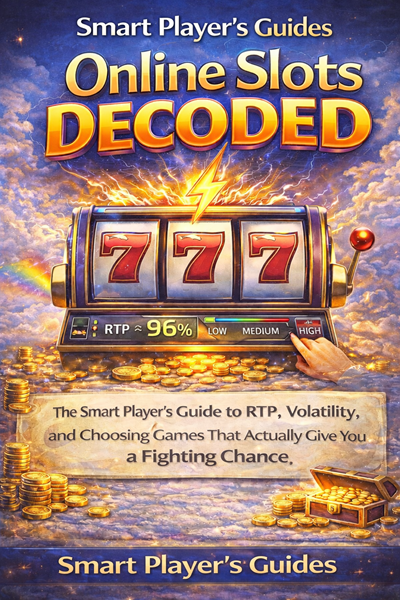
For the complete masterclass in slots and casino strategy, check out the full ebook: Online Slots Decoded: The Smart Player’s Guide to RTP, Volatility, and Choosing Games That Actually Give You a Fighting Chance.
- Available on Google Play: https://play.google.com/store/books/details?id=8MnCEQAAQBAJ
- Available on Amazon: https://www.amazon.com/dp/B0GPSSWZQ7