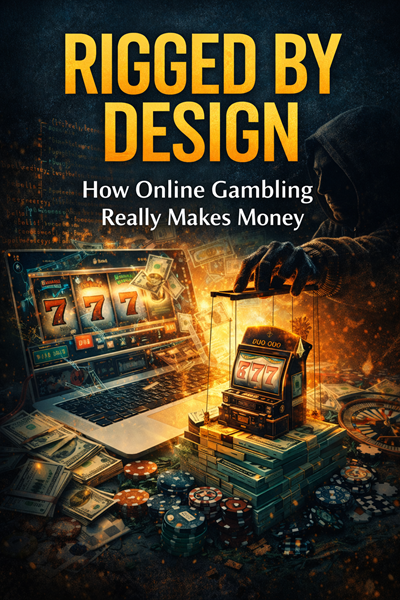
Rigged by Design
Online gambling is a meticulously engineered ecosystem where mathematical certainty and cognitive psychology are used to guarantee operator profits. This structural dissection reveals that the industry is built upon data-driven statistical models rather than the unpredictable “luck” perceived by players. By integrating these unbreakable laws of probability with behavioral economics, platforms ensure that revenue extraction remains a predictable and inevitable outcome of the extractive architecture.
It Feels Random — It Isn’t
Online casinos utilize Pseudo-Random Number Generators (PRNGs) that produce a massive number output ranging from 1 to 4,294,967,296 based on variables like system clock milliseconds. While the software picks from these 4.2 billion possible numbers in a technically unbiased manner, it maps the results to outcomes using weighted digital reels and asymmetrical odds. This distinction ensures that while the specific selection is random, the pool is structurally stacked to ensure a built-in house edge that favors losing combinations and low-value symbols.
The House Edge Is Just the Surface
While a theoretical house edge might sit at a modest 4%, the actual “hold” for the casino is significantly higher because the spin cycle grinds away at every reinvested wager. For example, a $100 deposit often generates $1,000 in total wagers before depletion, allowing a 4% edge to manifest as a 30% actual hold for the operator. Casinos weaponize variance and volatility as strategic tools to mask this steady mathematical decline, presenting the bankroll’s inevitable erosion as a series of unpredictable swings.
Winning Is Built Into the Model
Operators utilize “early reinforcement” to anchor a memory of victory in a player’s mind, ensuring future loyalty is purchased with a small, early payout. The digital architecture also employs Losses Disguised as Wins (LDWs), where celebratory sensory feedback is triggered for payouts that are actually lower than the original wager. These engineered wins are a calculated cost of customer acquisition designed to extend Time on Device (TOD) and maximize exposure to the house edge.
Variable Rewards and Dopamine Loops
The mechanics of online gambling exploit intermittent reinforcement schedules where unpredictable rewards trigger intense dopamine spikes during the anticipation of the result rather than the payout itself. This effect is further manipulated by the “near miss,” a theatrical visual display specifically coded to simulate “almost winning” despite the software having already selected a losing number. This neurological manipulation creates a powerful compulsion to bet again by tricking the brain into perceiving a failed attempt as an acquisition of skill.
The Illusion of Control
Casinos weaponize the human instinct for pattern recognition by providing useless “hot” and “cold” data that encourages the Gambler’s Fallacy, the false belief that past outcomes affect future independent trials. This illusion tricks players into making “strategic” decisions against a static mathematical advantage where past events have zero bearing on future probabilities. Even in skill-based games like Blackjack, a player’s confidence in “gut feelings” often blinds them to the reality that rules like the dealer acting last ensure permanent structural dominance for the house.
Escalation
The rapid pace of digital play removes the friction of physical reality, inducing a trance-like “zone” where money is perceived only as meaningless digital credits. This accelerated gameplay allows the house edge to grind through bankrolls with clinical efficiency while preventing the natural pauses that might break a player’s focus. When losses occur, the psychological drive of loss aversion often compels players to chase their deficits by increasing bet sizes through frictionless, one-click digital interfaces.
Bonuses Aren’t Generosity
Casino bonuses function as mathematical tethers that use “playthrough” or “rollover” requirements to bind a player’s real funds to the house edge. For example, a $100 bonus with a 30x rollover on a $200 combined balance requires $6,000 in wagering, which—at a 95% RTP—guarantees a $300 expected mathematical loss. These promotions act as retention tools that lock a player’s capital into the ecosystem until it is statistically exhausted or the original deposit is consumed.
VIP Programs and High-Value Targeting
Sophisticated segmentation algorithms identify high-value targets who are then assigned personal account managers to foster parasocial relationships and deep emotional loyalty. These VIP programs utilize personalized incentives and “loss rebates” to manage the emotional volatility of big losers and ensure they continue depositing fresh capital. From the operator’s perspective, these rebates are merely a recycling mechanism used to maintain engagement until the house edge eventually reclaims the recycled funds.
Affiliates and Funnel Engineering
Online casinos acquire customers through a decentralized network of third-party affiliates who use search-optimized content to funnel high-intent traffic toward specific operators. These marketers are compensated via Cost Per Acquisition (CPA) or Revenue Share models, the latter of which provides the affiliate with a percentage of the referred player’s net losses for life. This financial structure ensures that the entire ecosystem, including websites offering “winning tips,” is incentivized to profit from the statistical certainty of the player’s eventual total loss.
Lifetime Value
Operators prioritize Lifetime Value (LTV), aiming for a “slow bleed” that keeps players active and depositing rather than triggering a “bust out” through sudden, massive losses. Within this model, a database of 100,000 active players each depositing $50 monthly leads to a $60,000,000 yearly aggregate loss for the player base. Even publicized multi-million dollar jackpots are viewed as marketing expenses that have already been fully funded by the aggregate network of players through progressive siphoning.
Why Casinos Rarely Lose Overall
The structural invincibility of a casino relies on the Law of Large Numbers, which ensures that individual variance is flattened into predictable profit as the volume of wagers increases. In the sports betting sector, operators use the “vig” and dynamic line adjustments to balance action on both sides of a game, such as the Chiefs vs. 49ers, to minimize their own risk. By successfully balancing their books, sportsbooks act as risk-free toll booths that collect a commission on the volume of play rather than participating in the gamble.
Regulation Doesn’t Change the Blueprint
While regulation prevents outright fraud and ensures technical compliance, its primary function is to codify and legitimize the extractive nature of the house edge. Government audits of RNG software merely certify that the machine is functioning exactly as intended: to take a specific, advertised percentage of every dollar wagered. Furthermore, responsible gambling initiatives often shift the burden of responsibility onto the individual player while providing a legal framework for operators to continue using highly sophisticated psychological weapons.
Why Smart People Still Get Pulled In
Analytical individuals often fall into an “intelligence trap” where they believe their problem-solving skills can solve or outsmart mathematically unsolvable and independent algorithms. This drive to find order in chaos leads to deeper engagement and an emotional refusal to admit defeat, causing the player to override logic with desperate “emotional math.” Narrative bias reinforces this behavior, as players vividly remember wins while dismissing grinding losses as temporary bad luck rather than a structural certainty.
Can Anyone Beat It?
Advantage Play methods such as card counting are effectively obsolete online because Random Number Generators reset the virtual deck after every single hand. While “bonus hunting” can theoretically offer a positive expected value, it is a fragile endeavor because casinos use risk teams to initiate gubbing the moment a player shows a mathematical edge. The house maintains the unilateral right to restrict or close accounts the moment a player is no longer profitable, ensuring the system remains a one-sided extraction.
Seeing the Design Clearly
Breaking the compulsion to gamble requires a paradigm shift where the online casino is viewed as an automated toll booth designed for steady confiscation rather than an opponent to be defeated. Deconstructing the mechanics of “near misses” and VIP perks reveals them as calculated tools of bankroll recirculation rather than genuine coincidences or rewards. Understanding that every new bet simply exposes more capital to a negative expected value equation neutralizes the emotional momentum required to continue playing.
Also for Sale
This book authored by Casino Online Gaming is also available for sale at Google books for $14.99.